
Overview and Historical Context
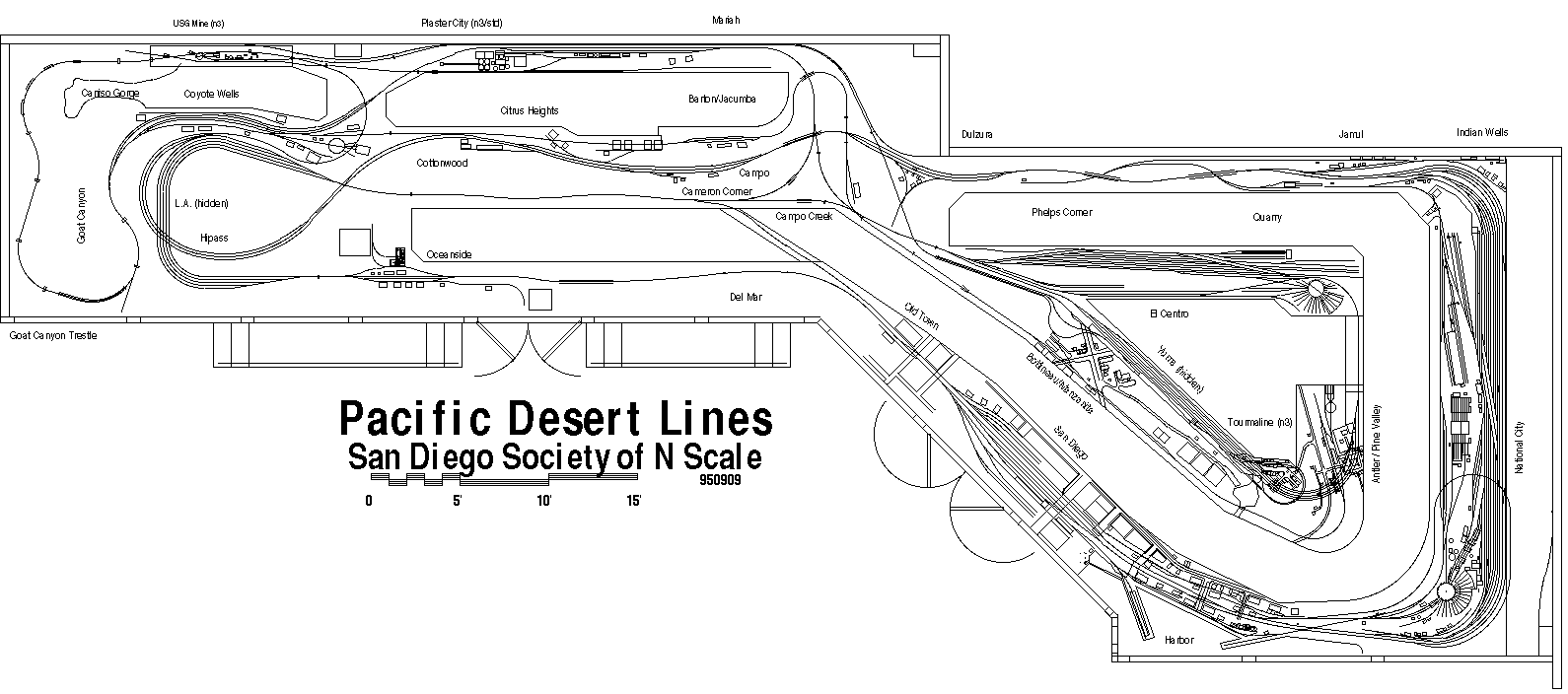
The Pacific Desert Lines (PDL) stands as one of the world’s largest permanent N-scale model railroad layouts, representing the creative vision and technical craftsmanship of the San Diego Society of N Scale (SDSoNS). This impressive layout recreates a fascinating historical “what-if” scenario, depicting a route that might have existed had history taken a slightly different turn.
The PDL operates along a meticulously modeled route connecting San Diego to El Centro, California, featuring strategic interchanges with the Atchison, Topeka & Santa Fe Railway (ATSF) in San Diego and the Southern Pacific (SP) in El Centro. What makes this railroad particularly intriguing is its historical foundation—the layout is based on an actual 1855 survey conducted by the San Diego and Arizona Eastern Railroad (SD&AE).
This early survey explored the possibility of maintaining the entire route within United States territory, despite the engineering advantages of crossing into Mexican valleys with their more favorable grades. Ultimately, history took a different course, and when the actual railroad was constructed following a later 1906 survey, the line did indeed cross international boundaries into Mexico several times. The PDL thus preserves an alternate historical vision of what might have been—a completely American route that never materialized in the real world.
Locomotive Fleet and Operations
The PDL’s motive power roster remains dynamic, as club members continually contribute their personally painted locomotives in the club’s color scheme. However, the core fleet typically includes a diverse range of diesel-electric locomotives that remain on the layout for regular operation, including:
- E-8/9 passenger diesels for priority service
- PA passenger engines
- SD-7/9 road switchers
- GP 7 & 9’s road switchers
- RSD 4 & 5’s road switchers
- S-2 and S-4 yard switchers
These club-owned locomotives form the backbone of computerized operations that entertain museum visitors during public hours.
The PDL’s operations are further enhanced by “leased” or “borrowed” power from connecting railroads, primarily representing the ATSF, SP, and Union Pacific (UP)—accurately reflecting how prototype railroads often share motive power through trackage rights and interchange agreements.
Club members often bring their personal steam locomotives to operate during weekend sessions, adding unexpected variety and historical depth to the layout’s operations.
The layout technically encompasses a broad timeframe from the early 1920s through the 50s.